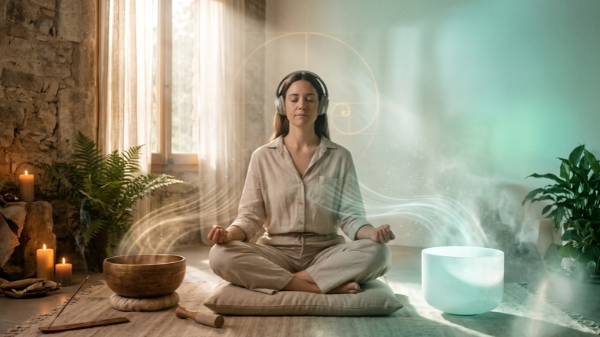

Spend five minutes browsing sound-healing playlists or digital meditation libraries, and you will immediately run into a fierce debate between two numbers: 432 Hz and 528 Hz. Fans of 432 Hz call it the “Golden Ratio pitch” and the harmonic heartbeat of nature. They point to ancient stone chambers and Italian composer Giuseppe Verdi. Meanwhile, proponents of 528 Hz call it the “Miracle Tone” or “Love Frequency” of the ancient Solfeggio scale. They credit it with emotional renewal and solar plexus vitality.
When you are trying to build a practical, 5-to-15-minute daily listening habit to lower stress, clear mental clutter, and focus on your financial or personal goals, which frequency actually performs better—and do you have to choose just one? Below, we compare 432 Hz vs. 528 Hz for manifestation and healing. We look at acoustic physics, published cortisol studies, archaeoacoustics, and daily listening comfort. As a result, you can pick the right sound for your nervous system.
Disclosure: This article contains affiliate links. If you purchase through these links, we may earn a commission at no additional cost to you. All audio frequency, brainwave entrainment, and manifestation concepts discussed are for relaxation, mindset, and entertainment purposes only and do not constitute financial, medical, or psychological advice. Individual experiences vary, and no financial outcomes are guaranteed.
Acoustic Physics vs. Spiritual Tradition: Understanding Solfeggio and Verdi Tuning
The biggest source of confusion in the 432 Hz vs. 528 Hz debate is that people talk about them as if they are two competing pure tones on the exact same ruler. In acoustic physics and musicology, 432 Hz and 528 Hz are actually two different types of frequency systems:
- 432 Hz Is a Musical Reference Tuning Standard (A₄ = 432 Hz):
In modern Western music, instruments are tuned so the A note above middle C vibrates at 440 Hz. When a sound engineer tunes an entire synthesizer, piano, or ambient orchestra down by 8 Hz (or -31.77 cents) so that A₄ = 432 Hz, every single note and chord in the composition shifts proportionally downward. Because it is a full-spectrum musical tuning standard (known historically as Verdi’s A), 432 Hz allows composers to write rich, multi-layered melodies, chord progressions, and ambient soundscapes that never feel monotonous. - 528 Hz Is a Specific Single Tone From the Solfeggio Scale (MI = 528 Hz):
Derived from 11th-century Gregorian chant hymns (popularized in the 1970s by Dr. Joseph Puleo and Dr. Leonard Horowitz), the Solfeggio scale consists of specific standalone frequencies—most notably 396 Hz, 417 Hz, 528 Hz, 639 Hz, 741 Hz, and 852 Hz. Notice that in scientific pitch notation (C₄ = 256 Hz, which happens to pair mathematically with A₄ = 432 Hz), the note C₅ (one octave above middle C) vibrates at 512 Hz to 528 Hz. However, most commercial “528 Hz tracks” play a continuous 528 Hz pure sine drone or chime throughout the entire track.
(Want to see how the top commercial audio bundles implement these two systems? Check out our companion commercial hub: 5 Best 432 Hz Manifestation Audio Programs (2026 Ranked)).
432 Hz Breakdown: Cortisol Reduction, Alpha/Theta Entrainment, and Grounding
Perhaps your main struggle is physical tension, racing thoughts, or chronic work anxiety. In that case, 432 Hz has some of the more interesting clinical data for calming the nervous system. However, the studies are small, so treat the results as promising rather than settled.
What Peer-Reviewed Clinical Trials Confirm About 432 Hz
Unlike many New Age claims that have never been tested in a hospital or university setting, 432 Hz tuning has been evaluated in multiple double-blind crossover trials and randomized clinical studies against standard 440 Hz music (We audit the exact methodology and p-values of every paper in Does 432 Hz Really Lower Cortisol? Examining the Clinical Studies Behind the Hype):
- 63.7% Lower Post-Stress Salivary Cortisol (PMID: 32401941): In a randomized clinical trial by Aravena et al. (2020) measuring patients undergoing acute dental surgery stress, listening to 432 Hz music for 15 minutes resulted in a mean salivary cortisol level of 0.49 µg/dL, compared to 1.35µg/dL in the 440 Hz group and 1.59µg/dL in the control group p less than 0.05).
- Significant Heart Rate Reduction (PMID: 31031095): In a double-blind crossover trial by Calamassi and Pomponi (2019), 20 minutes of 432 Hz music lowered mean heart rate by -4.79 bpm (p = 0.05) and improved listener concentration scores compared to identical tracks at 440 Hz.
- Lower Systolic Blood Pressure & Improved Sleep (PMCID: PMC9534204): A 2022 double-blind clinical trial on emergency nurses during high-stress shifts found that brief 432 Hz listening breaks significantly lowered respiratory rate (-2.71 breaths/min}, p less than 0.001), systolic blood pressure (-3.82 mmHg, p = 0.031), and acute anxiety scores, while a 2020 crossover sleep trial showed a +3.6 point improvement in sleep quality (p = 0.02).
Why 432 Hz Excels for Daily Manifestation Rituals
Because 432 Hz lowers heart rate and cortisol within 5 to 15 minutes without sounding like a repetitive test tone, it acts as a gentle acoustic bridge out of high-beta stress (18–30 Hz) into alpha (8–12 Hz) and theta (4–8 Hz) awareness (Learn why this stops wandering thoughts in Why You Can’t Focus During Manifestation Meditation).
528 Hz Breakdown: The “Miracle Tone” and Emotional Clarity
While 432 Hz feels warm, grounding, and earth-centered, 528 Hz occupies a slightly higher, brighter acoustic register that sound therapists associate with emotional uplift, heart/solar-plexus energy, and active daytime motivation.
What Peer-Reviewed Science Actually Says About 528 Hz
To maintain strict E-E-A-T accuracy, it is crucial to separate viral internet myths about 528 Hz from actual endocrine studies:
- The Endocrine & Oxytocin Study (Akimoto et al., 2018 — PMID: 30414050): In a clinical study published in the Journal of Addiction Research & Therapy by K. Akimoto and colleagues, healthy participants listened to music tuned to 528 Hz versus 440 Hz for just 5 minutes. In the 528 Hz group, mean salivary cortisol decreased significantly ($p \text{ less than } 0.05$) 30 minutes after listening, while salivary oxytocin (often associated with emotional bonding and calm trust) increased significantly immediately after listening—accompanied by reduced tension-anxiety scores on the Profile of Mood States (POMS).
- The “DNA Repair” Caveat: You will frequently see blogs claim that 528 Hz “repairs human DNA in your living room.” In reality, the laboratory studies referenced (such as Babayi & Riazi, 2017) exposed isolated in vitro cell cultures in petri dishes to 528 Hz acoustic waves to observe oxidative stress resistance. Listening to a 528 Hz MP3 file in headphones does not medically alter or repair your genetic code—and any legitimate review must make that clear.
The Practical Drawback of Pure 528 Hz Tracks
Because 528 Hz sits in the upper-middle frequency band (just above C₅), listening to an unmodulated 528 Hz sine wave drone for more than 10 to 15 minutes can feel sharp or fatiguing to sensitive ears—which is why many users of Solfeggio-heavy programs like Midas Manifestation eventually prefer warmer 432 Hz ambient arrangements (See our full comparison in Shifting Vibrations vs. Midas Manifestation: $47 vs. $37 Audio Bundle Compared).
Side-by-Side Comparison Matrix (Use Cases, Brainwave States, Best Time to Listen)
Here is how 432 Hz and 528 Hz compare across every practical dimension for daily listeners:
| Comparison Dimension | 432 Hz (Verdi / Golden Ratio Tuning) | 528 Hz (Solfeggio “Miracle” Tone) |
|---|---|---|
| Acoustic Structure | Full musical tuning standard (A₄ = 432 Hz); warm harmonic chords & overtones. | Specific target frequency (528 Hz, near C₅); brighter, chiming resonance. |
| Subjective Ear Feel | Deep, warm, grounding, and soothing; zero ear fatigue over 20-minute sessions. | Bright, uplifting, and energizing; pure tones can feel intense after 15 minutes. |
| Verified Biomarker Shifts | Lowers heart rate (-4.79 bpm), salivary cortisol (-63.7% vs 440 Hz), systolic BP, and improves sleep scores. | Lowers salivary cortisol after 5-min exposure and increases salivary oxytocin (PMID: 30414050). |
| Primary Brainwave Synergy | Alpha (8–12 Hz) & Theta (4–8 Hz): Ideal carrier for stereo binaural beats and pre-sleep delta transitions. | Alpha (8–12 Hz) & Low-Beta (12–15 Hz): Best for awake emotional clarity and active motivation. |
| Chakra / Esoteric Association | Heart, Third Eye (Pineal), and Earth Grounding (φ = 1.618 Golden Ratio). | Solar Plexus (Manipura — willpower) and Heart (Anahata — emotional warmth). |
| Best Time of Day to Listen | Early Morning (Cortisol Reset), Deep Meditation & Bedtime (Pre-Sleep). | Mid-Morning or Afternoon when you want an emotional mood lift. |
| Top Commercial Program | Shifting Vibrations by AstralHQ ($47 / 10 Tracks) | Midas Manifestation ($37 / 5 Tracks) |
Archaeoacoustics: How Ancient Cultures Used Resonant Chambers
One reason 432 Hz dominates modern abundance and consciousness programs is its direct mathematical relationship to ancient stone chamber acoustics.
As we documented in our archaeoacoustics deep dive (The King’s Chamber Resonant Frequency: Inside Ancient Egyptian Archaeoacoustics), acoustic measurements inside the red granite King’s Chamber of the Great Pyramid of Giza—as well as prehistoric chambers like Malta’s Hypogeum and Ireland’s Newgrange—reveal primary standing-wave resonances clustered between 108 Hz and 121 Hz.
In UCLA biobehavioral EEG studies (Cook et al., 2008), exposing the human brain to resonant frequencies around 110 Hz rapidly quieted left-prefrontal verbal chatter (the seat of anxious overthinking) and shifted cortical dominance to the right hemisphere.
When you scale a 108 Hz fundamental chamber resonance upward by two musical octaves (108 Hz x 2 = 216 Hz; 216 Hz x 2 = 432 Hz), you arrive directly at 432 Hz. This allows modern audio engineers to build rich harmonic chords where the bass root (108 Hz) and midrange carrier (432 Hz) lock together in natural octave consonance (Explore the Golden Ratio math in The Egyptian Golden Ratio Frequency (432 Hz): Myth, Acoustics, and Mindset).
Choosing the Right Frequency Stack for Your Daily Meditation Routine
Rather than viewing sound frequencies as magic spells, treat them as precision nervous-system tools:
- When to Choose 528 Hz: If you are already calm and well-rested, enjoy traditional Eastern chakra theory, and want a short daytime mood boost or a 118-page spiritual reading manual, a Solfeggio program like Midas Manifestation ($37) covers the 528 Hz and 639 Hz tones well.
- When to Choose a Multi-Layered 432 Hz + Binaural + Subliminal Stack: If your goal is to quiet morning anxiety, stop mind-wandering during visualization, reprogram limiting habits with masked subliminals, and fall asleep faster at night, 432 Hz is the superior daily foundation.
Why Shifting Vibrations Is Our #1-Ranked 432 Hz Audio System
Inside Shifting Vibrations by AstralHQ ($47 one-time payment for 10 uncompressed MP3/M4A files), creator Kai goes far beyond a simple single-tone loop by stacking three complementary acoustic technologies across the 10-track curriculum:
- Pure 432 Hz Golden Ratio & Chamber Resonance Tracks: Track 1: Egyptian Golden Ratio for Abundance (432 Hz), Track 2: The Abundance Pyramid (432 Hz), Track 5: Golden Ratio Experience, and Bonus 3: Royal Awakening use warm 432 Hz harmonic tuning that you can play over room speakers or headphones in just 5 to 15 minutes a day (Follow our daily schedule in How to Use 432 Hz Frequency for Manifestation in 5 Minutes a Day).
- Stereo Theta Binaural Beats (4–8 Hz): Track 6: New Horizons Astral Experience, Bonus 1: Astral Starwaves, Bonus 2: Rainy Winter (for desk focus), and Bonus 4: Stormy Escape (for sleep) use dichotic left/right ear offsets to guide the thalamus and pineal rhythm into deep theta stillness (See how this works in Sound Frequency to Activate the Pineal Gland and 5 Best Hemi-Sync Alternatives).
- Sub-Audible Subliminal Affirmations: Track 3: Shaman Beats and Track 4: Lucid Oddysee embed positive abundance cues beneath the theta carrier wave so your subconscious absorbs supportive scripting during afternoon meditation or the 15-minute pre-sleep window (Compare the mechanics in Subliminal Affirmations vs. Binaural Beats for Money and Can You Listen to 432 Hz While Sleeping?).
Keep one principle in mind: neither 432 Hz nor 528 Hz can deposit cash into your bank account without real-world action. A daily 5-to-15-minute listening ritual may help you relax, sleep better, and think more clearly. In turn, a calm and focused mind can spot opportunities and act on them without self-sabotage.
Because Shifting Vibrations is a one-time $47 download backed by ClickBank’s 60-day 100% money-back guarantee (which you can claim directly at clickbank.com with zero hassle—see Is Shifting Vibrations Legit or a Scam?), you can test all 10 tracks in your daily routine completely risk-free.
Interactive 432 Hz vs. 528 Hz Acoustic & Clinical Comparator
Finally, use the interactive 432 Hz vs. 528 Hz Acoustic & Clinical Comparator below. It compares both frequencies across reported biomarker shifts, listening comfort over 20-minute sessions, brainwave entrainment compatibility, and recommended daily time slots.