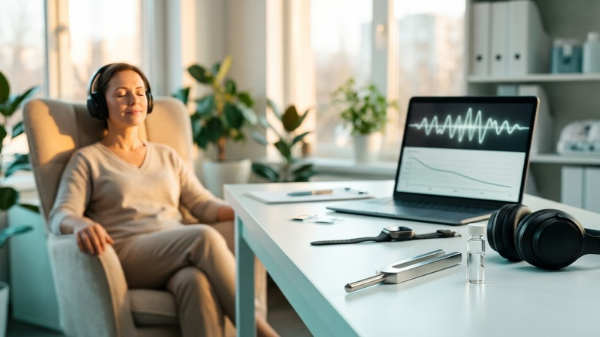

If you have watched the promotional video for Shifting Vibrations by AstralHQ—or browsed the footnotes at the bottom of its sales page—you will notice something unusual for a spiritual audio product: a bibliography of peer-reviewed studies from PubMed, the National Center for Biotechnology Information (NCBI), and clinical dentistry journals.
On one side of the internet, manifestation marketers claim that listening to A = 432 Hz unlocks an ancient biological “abundance switch” that attracts effortless wealth. On the opposite side, internet skeptics dismiss 432 Hz tuning as pure placebo pseudoscience, insisting that an 8 Hz shift from standard 440 Hz tuning is completely imperceptible to the human nervous system.
When you pull the actual peer-reviewed clinical papers from PubMed and read the raw data, both extremes turn out to be wrong:
- The Clinical Fact: Multiple randomized controlled trials and double-blind crossover studies confirm that listening to music tuned to 432 Hz produces statistically significant reductions in salivary cortisol (the body’s primary stress hormone), lowers mean heart rate (-4.79 bpm), reduces systolic blood pressure, and improves sleep scores more effectively than identical music tuned to standard 440 Hz.
- The Marketing Extrapolation: None of those university trials tested or proved “automatic financial manifestation.” Rather, 432 Hz audio works by measurably calming the hypothalamic-pituitary-adrenal (HPA) axis and clearing stress-induced “mental static” so your prefrontal cortex can focus, plan, and execute without anxiety.
Below, we audit the four landmark clinical trials on 432 Hz versus 440 Hz tuning—including exact sample sizes, p-values, and biomarker shifts—so you can see what the science actually proves.
Disclosure: This article contains affiliate links. If you purchase through these links, we may earn a commission at no additional cost to you. All audio frequency, brainwave entrainment, and manifestation concepts discussed are for relaxation, mindset, and entertainment purposes only and do not constitute financial, medical, or psychological advice. Individual experiences vary, and no financial outcomes are guaranteed.
Summary Matrix: The 4 Landmark Clinical Trials on 432 Hz vs. 440 Hz
Before examining each study in detail, this table summarizes the verified clinical literature comparing 432 Hz tuning against standard 440 Hz tuning (See how top audio programs apply these findings in our main hub guide: 5 Best 432 Hz Manifestation Audio Programs (2026 Ranked)):
| Clinical Study & Citation | Study Design & Sample | Intervention Protocol | Key 432 Hz vs. 440 Hz Findings | Statistical Significance |
| 1. Aravena et al. (2020) J Appl Oral Sci (PMID: 32401941 / PMC7213780) | Parallel-group randomized clinical trial (N = 42 dental surgery patients) | 15 mins of 432 Hz (n=15), 440 Hz (n=15), or No Music Control (n=12) | Salivary Cortisol: 0.49 µg/dL (432 Hz) vs. 1.35 µg/dL (440 Hz) vs. 1.59 µg/dL (Control) | p less than 0.05$ (Significant cortisol drop only in 432 Hz group) |
| 2. Calamassi & Pomponi (2019) Explore (NY) (PMID: 31031095) | Double-blind crossover pilot study (N = 33 healthy volunteers) | 20 mins of identical movie soundtracks tuned to 432 Hz vs. 440 Hz on separate days | Mean Heart Rate: -4.79 bpm decrease at 432 Hz; slight respiratory rate drop & higher focus | p = 0.05 (Significant heart rate reduction vs. 440 Hz) |
| 3. Calamassi et al. (2022) Acta Biomed (PMCID: PMC9534204) | Double-blind, 3-arm randomized controlled pilot (N = 54 ER nurses, 83 sessions) | Work-break listening at 432 Hz, 440 Hz, or free break during COVID-19 shifts | Vital Signs & Stress: STAI-X1 anxiety dropped (34 → 29); RR (-2.71 b/min) & SBP (-3.82 mmHg) dropped | p = 0.001 (Anxiety), p less than 0.001 (RR), p = 0.031 (SBP) |
| 4. Calamassi et al. (2020) Spinal Cord Ser Cases | Crossover clinical study (Delayed sleep & spinal cord rehab patients) | Pre-sleep listening to 432 Hz music vs. 440 Hz music across separate periods | Sleep Quality Scores: +3.6 point sleep improvement at 432 Hz vs. -0.7 at 440 Hz | p = 0.02 (Significant sleep quality improvement) |
Study #1: The Salivary Cortisol Trial (Aravena et al., 2020 — PMID: 32401941)
When skeptics ask whether 432 Hz really lowers cortisol, the definitive peer-reviewed reference is the 2020 randomized clinical trial conducted by Dr. Pedro Christian Aravena and colleagues at the Austral University of Chile, published in the Journal of Applied Oral Science (PMID: 32401941, PMCID: PMC7213780).
Why Dental Extraction Is the Ultimate Stress Test
Measuring stress in a quiet bedroom is difficult because baseline cortisol is already low. In clinical medicine, acute tooth extraction surgery is considered a gold-standard physiological stress model because waiting for an oral surgeon’s anesthetic syringe reliably spikes the human sympathetic nervous system and floods saliva with cortisol.
Methodology & Biomarker Results
The Setup: Forty-two patients with moderate-to-high clinical anxiety were randomly assigned into three parallel groups right before oral surgery:
- Group 1 (n = 15): Listened to instrumental music tuned to 432 Hz through headphones for 15 minutes.
- Group 2 (n = 15): Listened to the exact same musical tracks tuned to standard 440 Hz for 15 minutes.
- Group 3 (n = 12): Control group waiting without music.
Subjective Anxiety (CORAH-MDAS Scale): Both music groups reported significantly lower subjective anxiety scores (8.7 ± 2.67 for 432 Hz and 8.4 ± 2.84 for 440 Hz) compared to the no-music control group (17.2 ± 4.60, p < 0.05).
The Objective Salivary Cortisol Difference (ELISA Assay): When researchers analyzed unstimulated saliva samples in the laboratory using enzyme-linked immunosorbent assay (ELISA), a striking biological difference emerged between the two tuning frequencies:
Control Group (No Music): 1.59 ± 0.70 µg/dL salivary cortisol
440 Hz Music Group: 1.35 ± 0.69 µg/dL salivary cortisol
432 Hz Music Group: 0.49 ± 0.37 µg/dL salivary cortisol (p less than 0.05)
The Clinical Takeaway: While listening to standard 440 Hz music helped patients feel distracted from their anxiety on a questionnaire, their bodies still maintained high biological cortisol (1.35 µg/dL). By contrast, just 15 minutes of 432 Hz music produced a 63.7% lower post-intervention salivary cortisol level than 440 Hz music (0.49 µg/dL vs. 1.35 µg/dL).
Study #2: Double-Blind Heart Rate & Focus Trial (Calamassi & Pomponi, 2019 — PMID: 31031095)
Could the cortisol drop simply be a placebo effect from people knowing they are listening to “healing 432 Hz music”? To eliminate expectation bias, Italian researchers Diletta Calamassi and Gian Paolo Pomponi conducted a double-blind crossover pilot study published in Explore: The Journal of Science & Healing (PMID: 31031095).
- Double-Blind Crossover Protocol: Neither the 33 healthy participants nor the researchers administering the session knew whether the headphones were playing 432 Hz or 440 Hz on a given day. Every participant listened to the exact same movie soundtracks under both tuning conditions on separate days.
- Cardiovascular & Autonomic Shifts: Listening to the 432 Hz recordings produced a statistically significant decrease in mean heart rate of -4.79 bpm (p = 0.05) and a slight decrease in mean respiratory rate (-1 breath/min, p = 0.06) compared to 440 Hz.
- Cognitive Focus & Satisfaction: On post-session evaluations, participants blindly rated themselves as significantly more focused on listening and more satisfied after the 432 Hz session than after the 440 Hz session.
Studies #3 & #4: Emergency Nurse Burnout & Sleep Quality (PMC9534204)
Following their 2019 pilot, Calamassi and colleagues tested 432 Hz tuning in two high-friction real-world environments: hospital sleep recovery and frontline emergency room shifts.
- Emergency Room Nurse Stress Trial (2022 — PMCID: PMC9534204): In a randomized, double-blind, three-arm trial of 54 emergency first-response nurses during high-stress pandemic dayshifts, taking a short work break with 432 Hz music reduced State-Trait Anxiety Inventory (STAI-X1) scores from 34 down to 29 (p = 0.001), while uniquely lowering respiratory rate (-2.71 breaths/min, p less than 0.001) and systolic blood pressure (-3.82 mmHg, p = 0.031)—physiological shifts that did not reach significance in the 440 Hz group.
- Sleep Quality Crossover Study (2020): When patients listened to 432 Hz versus 440 Hz music prior to sleep, overall sleep scores improved by +3.6 points (p = 0.02) during the 432 Hz phase, compared to -0.7 points during the 440 Hz phase (See how to apply this at bedtime in Can You Listen to 432 Hz While Sleeping? Safety & Best Practices).
The Biophysics of 31.77 Cents: Why Does 432 Hz Soothe the Nervous System?
How can lowering a musical reference pitch by just 8 Hz (from A = 440 Hz down to A = 432 Hz, a pitch shift of -31.77 cents) alter salivary cortisol, heart rate, and blood pressure?
Psychoacoustic and neuro-auditory researchers point to three physical mechanisms (For a deeper look at how harmonic intervals are constructed, read The Egyptian Golden Ratio Frequency (432 Hz): Myth, Acoustics, and Mindset):
- Lower Basilar Membrane Tension: Inside your inner ear’s cochlea, higher pitch frequencies create mechanical displacement closer to the stiff base of the basilar membrane, which requires slightly higher sympathetic auditory vigilance. Dropping the entire harmonic overtone series by 31.77 cents softens upper-midrange transients (between 2,000 Hz and 4,000 Hz, where human hearing is most sensitive to alarm cries).
- Vagal Nerve (Cranial Nerve X) Stimulation: The auricular branch of the vagus nerve innervates the outer ear canal and tympanic membrane. Warmer, lower-tension harmonic resonance stimulates parasympathetic vagal tone, sending a direct brake signal to the heart’s sinoatrial node (explaining the -4.79 bpm heart rate drop) and signaling the HPA axis to halt cortisol secretion.
- Clearing High-Beta “Mental Static”: When cortisol and adrenaline drop, thalamocortical circuits inside the brain naturally shift out of anxious high-beta waves (18–30 Hz) and settle into calm alpha (8–12 Hz) and theta (4–8 Hz) rhythms (See how this pathway interacts with the thalamus and pineal gland in Sound Frequency to Activate the Pineal Gland: How Acoustic Entrainment Works).
Bridging Clinical Science to Your Daily Mindset Routine
Now that we have audited the clinical papers, let’s connect them honestly to wealth and abundance manifestation:
- Why Sales Page Hype Goes Too Far: When AstralHQ’s video presentation cites these PubMed studies and immediately jumps to stories of manifesting $1.4 million, it blurs the line between stress physiology and financial outcomes. Lowering your salivary cortisol from 1.35 µg/dL to 0.49 µg/dL will not magically cause checks to appear in your mailbox.
- Why 432 Hz Audio Still Gives You a Massive Real-World Edge: Chronic financial stress traps your brain in what neuroscientists call cortisol-induced tunnel vision. When your cortisol is spiked every morning, your prefrontal cortex (responsible for long-term planning, creative problem-solving, and disciplined execution) is hijacked by your amygdala (fear, procrastination, and scarcity panic).
By spending 5 to 15 minutes every morning listening to a studio-calibrated 432 Hz track—the exact duration tested in the Aravena et al. (15 mins) and Calamassi (20 mins) clinical trials—you physically lower your cortisol and heart rate before you sit down to work, negotiate, or manage your money (Follow our step-by-step protocol in How to Use 432 Hz Frequency for Manifestation in 5 Minutes a Day).
How Shifting Vibrations Applies These Clinical Durations
Inside the 10-track Shifting Vibrations audio bundle by AstralHQ ($47 one-time payment), the core tracks are intentionally mastered to match the 10-to-20-minute clinical window rather than bloated 8-hour background files (Read our full Shifting Vibrations Review (2026) or inspect all 10 files in Inside the Shifting Vibrations Audio Tracks List):
- Track 1: Egyptian Golden Ratio for Abundance (432 Hz) & Track 2: The Abundance Pyramid (432 Hz): Both tracks are 10-to-15-minute pure 432 Hz compositions designed specifically for morning cortisol reduction and clear-headed goal visualization.
- Track 5: Golden Ratio Experience (432 Hz) & Bonus 3: Royal Awakening (432 Hz): Built for midday work-break stress resets—mirroring the exact protocol used in the 2022 emergency nurse trial (PMC9534204).
- Tracks 3, 4 & 6 (Theta Binaural + Subliminal Layering): Stack stereo theta binaural beats and masked subliminal affirmations on top of the calming acoustic foundation.
Because every order is processed by ClickBank and protected by an unconditional 60-day 100% money-back guarantee (which you can claim directly at clickbank.com—see Is Shifting Vibrations Legit or a Scam?), you can test all 10 tracks against your own daily stress and focus levels completely risk-free.
Use the interactive Clinical Trial Data Explorer below to inspect the exact biomarker measurements from the published PubMed studies comparing 432 Hz, 440 Hz, and No-Music Control groups across salivary cortisol, heart rate, blood pressure, and sleep quality.