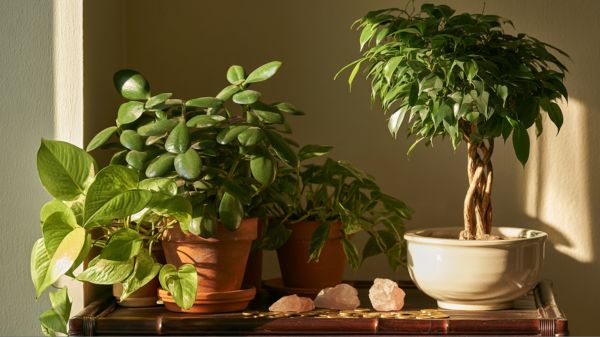


Bedroom love altars, when constructed with intentional plant groupings, rely on the Rule of Three to achieve visual and symbolic balance. A single tall specimen, one medium variety, and one low-growing plant form a triangular composition that directs emotional focus while resisting rigid symmetry. The selection of species, containers, and companion objects each carry distinct significance. What follows outlines the precise methodology for building such an altar effectively.
Key Takeaways
- Place the love altar in the relationship corner (far right from entrance), ensuring natural light, minimal traffic, and proper air circulation.
- Group houseplants in threes using one tall, one medium, and one short plant to create balanced, dynamic visual composition.
- Match containers in complementary materials and use risers to introduce varying elevation levels, strengthening the altar’s overall aesthetic cohesion.
- Pair plants with crystals, candles, and meaningful objects in sets of three, ensuring each element supports the altar’s romantic intention.
- Rotate plants and crystals seasonally—such as jasmine in spring or garnet in winter—to maintain fresh energy and symbolic alignment.
Why a Love Altar Belongs in Your Bedroom
Intention, when deliberately cultivated within a domestic space, has long been recognized across numerous cultural traditions as a means of reinforcing emotional and relational focus.
The bedroom, functioning as the most private zone within a residential environment, carries inherent spiritual significance, given its associations with rest, vulnerability, and intimate partnership.
Positioning a love altar within this space establishes a consistent visual and symbolic anchor, reinforcing a personal connection to relational intentions on a daily basis.
Unlike communal areas of a dwelling, the bedroom limits external disruption, thereby preserving the integrity of the altar’s purpose. Practitioners across various traditions have consistently noted that proximity to sleep cycles amplifies intentional focus, as the subconscious mind remains particularly receptive during periods of change between wakefulness and rest.
Why Grouping Plants in Threes Works for a Love Altar
When arranging houseplants on a love altar, grouping them in sets of three produces a triangular composition that distributes visual weight evenly across the designated surface, preventing any single point from dominating the overall arrangement.
The triangular configuration, which positions one plant at an apex and two at the base, creates a stable geometric structure that the human eye processes as balanced and complete, a principle well-documented in classical design theory.
Odd-numbered groupings, particularly three, resist the symmetrical rigidity of paired arrangements, generating instead a dynamic tension that sustains visual interest while maintaining compositional coherence.
Triangular Arrangement Creates Balance
Triangular arrangement, as a compositional principle, operates on the premise that three points of visual interest create a stable, dynamic structure that draws the eye across a defined space, and when applied to a bedroom love altar featuring houseplants, this principle functions by positioning plants of varying heights — one tall, one medium, and one low — so that an implied triangle is formed across the altar’s surface.
These triangular dynamics establish a visual hierarchy that prevents any single plant from dominating the composition, distributing attention deliberately across all three specimens. Spatial balance is achieved because the eye moves naturally between the three anchor points, creating a sense of completeness and intentional design. This structured asymmetry reinforces the altar’s aesthetic coherence while maintaining visual tension that sustains engagement with the arrangement.
Odd Numbers Enhance Visual Harmony
Three plants grouped together on a love altar engage the principle of odd-number composition, a design convention rooted in the observation that asymmetrical groupings resist the eye’s tendency to bisect a scene into equal halves, thereby generating sustained visual movement across the arrangement. This dynamic quality enhances visual balance, preventing compositional stagnation.
| Plant Count | Visual Effect |
| One plant | Isolated, static focal point |
| Two plants | Isolated, static focal point |
| Three plants | Symmetrical division, reduced movement |
Designers consistently observe that three-plant configurations compel the viewer’s gaze to travel between each specimen, establishing relational hierarchy without imposing rigid symmetry. The resulting aesthetic appeal emerges from deliberate variation in plant height, texture, and foliage density within the grouping.
How to Choose the Right Spot for Your Love Altar
Selecting an appropriate location for a love altar requires consideration of several spatial and energetic factors within the bedroom environment. Ideal locations typically include the relationship corner, identified in feng shui practice as the far right corner from the bedroom entrance, where energy accumulates most effectively.
Sacred spaces should remain undisturbed by high-traffic pathways, electrical interference from devices, and direct drafts that destabilize plant arrangements. Practitioners commonly evaluate natural light availability, ensuring houseplants receive adequate illumination without excessive heat exposure.
The altar surface should sit at a height permitting deliberate visual engagement, neither obstructed by furniture nor positioned beneath oppressive overhead structures. Wall proximity provides structural support for any vertical arrangements, while adequate floor clearance maintains proper air circulation around the plant groupings.
The Best Houseplants for a Love Altar and What They Symbolize
Certain houseplants carry longstanding symbolic associations with romantic love, emotional intimacy, and relational harmony, making them particularly suitable candidates for incorporation into a bedroom love altar. Thoughtful plant selection, guided by established love symbolism, strengthens the altar’s intentional focus.
| Plant | Symbolic Association | Care Level |
| Red Anthurium | Passionate love | Moderate |
| Pothos | Enduring connection | Low |
| Jasmine | Sensuality, attraction | Moderate |
Each specimen contributes a distinct symbolic layer, and selecting three plants, consistent with the Rule of Three principle, creates a compositionally balanced, meaningful arrangement. Practitioners should prioritize plants whose symbolism aligns directly with relational intentions, ensuring that aesthetic appeal and symbolic resonance function as complementary, rather than competing, design considerations.
How to Set an Intention Before You Build Your Love Altar
Before constructing a love altar with houseplants, an individual must first establish a clear and specific intention, as the precision of one’s love goals directly influences the altar’s symbolic alignment and energetic focus.
The practitioner should identify whether the intention pertains to attracting a new romantic partner, deepening an existing relationship, or cultivating self-love, as each distinct goal necessitates a different configuration of plants, objects, and spatial arrangement.
Visualization of the desired outcome, practiced through deliberate and structured mental rehearsal, reinforces the intention’s clarity and guarantees that the altar’s physical design remains coherent with the practitioner’s specific relational objectives.
Clarifying Your Love Goals
What one hopes to attract through a love altar determines the altar’s entire design, making the clarification of romantic intentions the essential first step in this process. Relationship intentions must be defined with precision before selecting any plant or object, as vague goals produce unfocused altars. Love visualization practices, such as journaling specific desires, strengthen the intentional foundation of the altar’s composition.
| Love Goal | Altar Focus | Recommended Plant |
| New Romance | Attraction energy | Jasmine |
| Deepening Commitment | Emotional bonding | Peace Lily |
| Self-Love | Personal healing | Rosemary |
Each category above directs the practitioner toward distinct plant selections, color schemes, and symbolic objects, ensuring every altar element reinforces the singular, clearly defined romantic intention established beforehand.
Visualizing Your Desired Outcome
Once romantic intentions have been clarified with precision, the practitioner must engage in structured visualization exercises that translate abstract desires into concrete mental imagery, reinforcing the altar’s eventual physical composition.
Emotional visualization, practiced consistently before altar construction begins, requires the practitioner to mentally inhabit specific relational scenarios, noting sensory details, interpersonal dynamics, and emotional atmospheres with disciplined accuracy. This cognitive rehearsal process functions as a preparatory protocol, aligning subconscious expectation with conscious design decisions.
Positive affirmations, repeated during visualization sessions, serve as declarative statements that reinforce intended outcomes, embedding directional intent into the practitioner’s psychological framework. Each affirmation must be constructed in present tense, active voice, and specific language, ensuring alignment between spoken intention and the altar’s forthcoming botanical and symbolic components.
✨ Take the guesswork out of designing your sacred space.
You have the layout down, but which plants actually hold the energy of wealth, peace, or protection? I’ve compiled the ultimate cheat sheet for you. Download my free eBook, The Sacred Garden: 25 Spiritual Plants for Healing, Protection & Abundance. 👉 Click here to grab your copy and finish your altar.
How to Group Three Plants by Color, Height, and Texture
Grouping three plants together on a bedroom love altar requires careful consideration of color, height, and texture, as these three elements work in concert to create a visually cohesive and intentional arrangement.
Strategic color combinations, such as pairing deep burgundy foliage with silvery-green leaves and bright emerald fronds, establish visual contrast while maintaining harmonic balance. Height variation guarantees dimensional interest, positioning the tallest plant at the rear, the medium plant at center, and the shortest plant at the front.
Texture distinctions, such as combining smooth, waxy leaves with feathery fronds and rough, ridged surfaces, add tactile and visual complexity. Practitioners should assess each plant individually before placement, ensuring that no single element dominates the arrangement disproportionately, thereby preserving the altar’s overall aesthetic integrity and intentional symmetry.
The Containers and Risers That Tie Your Love Altar Together
The selection of containers for a bedroom love altar plays a significant role in establishing visual cohesion, as matching pots in complementary materials, such as terracotta, ceramic, or glazed stoneware, unify the arrangement and prevent the display from appearing disjointed.
Risers, whether constructed from stacked books, wooden pedestals, or purpose-built plant stands, introduce varying elevation levels that create dimensional depth across the grouping, directing the viewer’s eye through the composition in a structured, deliberate manner.
The deliberate pairing of textured containers, such as ribbed ceramic vessels alongside smooth matte finishes, adds a layer of tactile and visual complexity that strengthens the overall aesthetic integrity of the altar display.
Matching Containers Create Harmony
Containers and risers, when selected with intention, serve as the unifying visual framework that anchors a bedroom love altar, drawing its disparate plant elements into a cohesive arrangement.
Selecting matching plant container styles, whether ceramic, terracotta, or glazed porcelain, establishes visual consistency across the arrangement, preventing the eye from perceiving individual elements as disconnected objects.
Color coordination functions as a secondary organizing principle, wherein containers sharing identical or analogous hues reinforce the altar’s intentional design rather than competing with the plants themselves.
A set of three identically styled containers, differing only in size, effectively honors the Rule of Three while maintaining the harmonic visual rhythm essential to a well-constructed altar. Consistent material choices further strengthen the overall composition, lending the arrangement a deliberate, unified aesthetic quality.
Risers Add Visual Depth
Risers introduce vertical variation into a love altar’s composition, elevating select plants to create layered sight lines that prevent the arrangement from appearing flat or monotonous. By strategically adjusting plant height through the use of wooden blocks, ceramic pedestals, or stacked books, one can achieve visual layering that draws the eye upward and across the entire arrangement.
A tall riser positioned at the rear of the altar accommodates larger specimens, while shorter risers placed at intermediate levels support medium-sized plants, and ground-level containers anchor the composition’s foreground. This deliberate tiering guarantees that foliage from each plant remains visible without obscuring neighboring specimens.
Risers constructed from materials that complement existing containers, such as matching wood tones or coordinating ceramic finishes, reinforce the altar’s overall aesthetic coherence.
Textures Elevate The Display
Texture, when applied thoughtfully across containers and risers alike, transforms a love altar from a simple plant grouping into a cohesive, dimensionally rich display. Layering techniques that incorporate varied surface qualities across every element reinforce visual interest without requiring additional plants. Textures to contemplate include:
- Rough terracotta beside smooth glazed ceramics
- Woven rattan risers beneath matte concrete pots
- Polished wood platforms contrasting raw linen-wrapped vessels
- Hammered metal containers placed alongside unfinished stone
Each pairing creates deliberate contrast, drawing the eye across the arrangement naturally. Selecting containers and risers that differ in tactile quality, while maintaining a unified color palette, guarantees the grouping reads as intentional rather than incidental. Consistency in tone unifies the disparate textures into one resolved composition.
How to Pair Plants With Crystals, Candles, and Meaningful Objects
Once the foundational plants have been selected and positioned, the layering of crystals, candles, and meaningful objects transforms a simple plant arrangement into a cohesive altar space, with each element chosen to complement the energetic and aesthetic properties of the plants it accompanies. Crystal harmony is achieved by matching stone frequencies to plant intentions, while candle placement follows the Rule of Three by anchoring light at varying heights.
| Plant | Paired Object |
| Rose Quartz Vine | Pink Candle |
| Lavender | Amethyst Crystal |
| Jasmine | Love Letter |
| Pothos | Clear Quartz |
| Peace Lily | Photograph |
Meaningful objects, positioned intentionally, complete the altar’s narrative, ensuring each component reinforces romantic intention through deliberate, thoughtful arrangement.
How to Keep Altar Plants Thriving in a Low-Light Bedroom
Many altar plants selected for their romantic and energetic properties, including pothos, peace lily, and lavender, are well-suited to low-light bedroom environments, though each species requires specific care adjustments to compensate for reduced photosynthetic input. Understanding light requirements and humidity needs guarantees sustained plant health within an altar arrangement.
- Rotating plants toward available window light every two weeks prevents uneven growth patterns
- Supplementing with a small grow light positioned discreetly behind altar objects maintains photosynthetic thresholds
- Grouping plants together on the altar surface increases localized humidity needs through transpiration exchange
- Monitoring soil moisture weekly prevents overwatering, a common consequence of reduced light-driven evaporation
Consistent attention to these variables preserves both the aesthetic integrity and energetic intention of the bedroom altar arrangement throughout seasonal light fluctuations.
Which Plants and Objects to Swap on Your Love Altar Each Season
Seasonal changes provide a practical framework for revitalizing a love altar’s botanical and symbolic components, as shifting environmental conditions, cultural associations, and energetic intentions naturally align with cyclical plant availability and dormancy patterns. Practitioners implementing deliberate plant rotations can consult the following seasonal symbolism reference:
| Season | Recommended Plants | Symbolic Objects |
| Spring | Jasmine, Tulips | Rose quartz, pink candles |
| Summer | Hibiscus, Lavender | Red jasper, sunstone |
| Autumn | Chrysanthemum, Sage | Amber, copper tokens |
Winter rotations favor dormant succulents alongside garnet stones. Each change warrants removing wilted specimens, cleansing surfaces, and introducing seasonally appropriate flora, ensuring the altar maintains botanical essence, aesthetic coherence, and intentional symbolic alignment throughout consecutive seasonal cycles.
Need the perfect plants for your new altar? Don’t buy anything until you read The Sacred Garden. Discover the top 25 plants for high-vibe living. Get the free book here.
Frequently Asked Questions
Can a Love Altar Work in a Shared Bedroom With a Skeptical Partner?
A love altar can function effectively within a shared bedroom, provided that shared space considerations are thoughtfully addressed through deliberate partner communication. One individual may designate a discreet corner, selecting minimalist houseplants that serve dual aesthetic purposes, thereby reducing potential friction. Transparent discussion regarding the altar’s placement, scale, and visual impact allows both occupants to negotiate boundaries, ensuring the arrangement remains unobtrusive, mutually tolerable, and functionally integrated within the shared environment.
Is It Bad Luck to Move or Dismantle a Love Altar Temporarily?
Like ripples fading in still water, dismantling a love altar temporarily carries no inherent bad luck. Temporary changes to a love altar depend entirely on personal beliefs and the spiritual significance one assigns to altar rituals. Many practitioners believe romantic energy resides within intention, not placement. Thoughtfully pausing altar rituals, while maintaining mindful awareness of the altar’s purpose, preserves its energetic integrity, allowing one to resume without consequence.
Should a Love Altar Face a Specific Direction for Best Results?
According to feng shui principles, altar orientation greatly influences energetic outcomes, with the southwest direction considered ideal for love altars, as it corresponds to the earth element and relational energy. Practitioners recommend positioning the altar so it faces northeast, allowing the individual to face southwest while engaging with it. Compass-based placement, combined with intentional arrangement, is regarded as foundational to maximizing the altar’s intended purpose.
Can Artificial Plants Be Used if Houseplants Keep Dying?
While some purists insist that only living plants carry authentic energy, artificial options remain entirely viable for those who struggle with plant care. Practitioners who consistently lose houseplants may incorporate high-quality plant alternatives into their love altar without compromising its intended purpose, as the symbolic representation of growth, energy, and natural abundance can still be effectively conveyed through carefully selected, realistic artificial specimens placed according to the Rule of Three.
How Long Before a Love Altar Starts Influencing Romantic Energy?
Practitioners generally observe shifts in romantic symbolism and energy flow within two to four weeks, provided the altar is consistently maintained, intentionally engaged with through daily reflection or ritual, and properly arranged according to symbolic principles. The timeline varies, however, depending on the individual’s belief framework, the clarity of their intention-setting practices, and whether the altar’s components, including plants or curated objects, are regularly refreshed and meaningfully selected.
Conclusion
A bedroom love altar, constructed according to the Rule of Three, functions as both an aesthetic and intentional focal point. Consider a hypothetical arrangement in which a six-foot fiddle-leaf fig, a mid-height peace lily, and a trailing pothos occupy a northeast corner shelf, anchored by rose quartz and a single taper candle. This triangular grouping creates spatial hierarchy, directs emotional attention, and sustains a cohesive symbolic environment, reinforcing romantic intention through deliberate, structured design.